
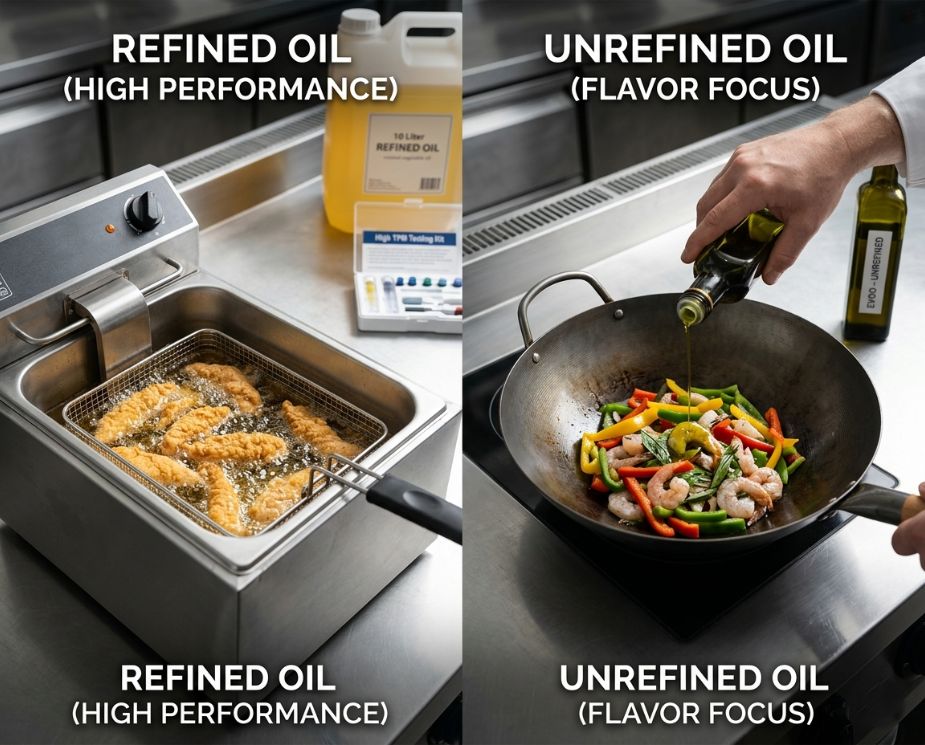
Choosing between refined and unrefined oil involves more than deciding whether you want a neutral flavour or a more distinctive one. The way an oil is processed can affect its aroma, appearance, cooking behaviour and suitability for different dishes.
For restaurants, takeaways, caterers and other foodservice businesses, these differences matter when selecting ingredients for frying, preparing sauces, dressing salads or finishing dishes. The right choice depends on the oil itself, the temperature it needs to withstand and the result you want to achieve.
This guide explains what refined oil is, what unrefined oil means, how the two compare and how to choose suitable oils for professional food preparation.
What is Refined Oil?
Refined oil is an oil that has undergone additional processing to remove or reduce unwanted components, such as certain impurities, odours, colours and free fatty acids. The exact process depends on the oil and the manufacturer’s method.
Common refining stages can include filtration, degumming, neutralisation, bleaching and deodorisation. Not every oil undergoes every stage.
These processes help produce an oil with more consistent characteristics, which can be useful when preparing large quantities of food or when the flavour of the oil should not dominate the dish.
What is Refined Cooking Oil Used For?
Refined cooking oils are used across a wide range of food preparation methods, including:
- Deep frying: Preparing chips, fried chicken, fish and other fried menu items.
- Shallow frying: Cooking ingredients in a pan where a relatively neutral flavour is preferred.
- Stir-frying: Cooking ingredients quickly at high temperatures, subject to the oil’s suitability.
- Baking and food preparation: Mixing into batters, doughs, marinades and other recipes.
- High-volume cooking: Preparing food consistently across repeated batches.
The best oil depends on its composition, refinement, smoke point and the temperature and duration of cooking. Refined oils often suit higher-temperature applications, but the label and specifications of the individual product should guide your choice.
For commercial cooking, explore wholesale vegetable oil for recipes where a versatile, relatively neutral cooking oil is required.
What is Unrefined Oil?
Unrefined oil is oil that has undergone less processing after extraction. Depending on the oil, it may retain more of its original colour, aroma, flavour, and naturally occurring minor compounds.
The term does not mean that an oil has received no processing at all. Unrefined oils may still be filtered or processed using methods intended to remove unwanted material while retaining more of their original characteristics.
Some unrefined oils have pronounced flavours that can contribute to the finished dish. Others have a milder taste. Their suitability for heating varies, so it is important not to assume that every unrefined oil has the same cooking properties.
What is Unrefined Cooking Oil Used For?
Depending on the particular oil, suitable applications may include:
- Salad dressings: Adding aroma and flavour to raw vegetables and other cold dishes.
- Finishing dishes: Providing a distinctive flavour when drizzled over food before serving.
- Cold preparations: Incorporating into dips, sauces and selected marinades.
- Gentle cooking: Using at appropriate temperatures where the oil’s characteristics suit the recipe.
For example, some less-refined olive oils are chosen for their fruity, peppery or grassy notes. These characteristics can be valuable when the oil is intended to contribute to the flavour rather than simply provide fat for cooking.
Explore olive oil and blended olive oil options to find products suited to your menu requirements.
Refined vs Unrefined Oil: Key Differences
The main difference between refined and unrefined oils is the extent and purpose of processing. However, processing alone does not tell you everything about an oil’s performance.
| Feature | Refined oil | Unrefined oil |
| Processing | Additional processing to modify or remove certain components | Less extensive processing, depending on the product |
| Flavour | Often mild or neutral | May retain more distinctive natural flavours |
| Colour and aroma | Often lighter or less pronounced | May have a stronger colour or aroma |
| Smoke point | Often higher than the same oil in an unrefined form | Can be lower, but varies by oil and processing |
| Cooking applications | Often suitable for frying and other heated applications | Frequently chosen for dressings, finishing and selected lower-heat uses |
| Consistency | Often offers a more standardised flavour and appearance | Characteristics may be more pronounced |
| Storage | Depends on the oil, packaging and storage conditions | Depends on the oil, packaging and storage conditions |
Important: These are general tendencies, not universal rules. An oil’s botanical source, fatty acid composition, free fatty acid content, refinement and condition all influence its performance. Always check the product specifications before selecting an oil for a particular cooking method.
How Does Refining Affect an Oil’s Smoke Point?
The smoke point is the temperature at which an oil begins to produce visible smoke under the conditions in which it is heated. It is useful when assessing an oil for cooking, but it should not be the only factor in your decision.
Refining can reduce free fatty acids and other components that contribute to smoking. As a result, a refined version of an oil often has a higher smoke point than its less-refined counterpart.
However, smoke point is not determined by refinement alone. Different oils have different compositions, and two oils described as refined may still perform differently when heated.
For foodservice businesses, the practical considerations include:
- The cooking temperature required by the recipe.
- How long the oil will remain heated.
- Whether the oil develops unwanted flavours or smoke.
- The type of food being cooked.
- The oil’s condition during use.
If you want to understand temperature limits in more detail, read our guide to the smoke points of cooking oils for professional kitchens.
Which is Better for Frying: Refined or Unrefined Oil?
Refined oil is often the more practical choice for deep frying and other high-temperature applications because it commonly has a higher smoke point and a milder flavour. Nevertheless, the right choice depends on the specific product and how it will be used.
For example, a takeaway preparing chips or a restaurant frying several batches of food may prefer a suitable refined vegetable oil or sunflower oil. A business preparing a dressing or finishing a dish may instead select an oil for its flavour.
Vegetable Oil for Everyday Commercial Cooking
Vegetable oil is a versatile option for many foodservice operations. Depending on its composition and specifications, it can be suitable for frying, baking and general food preparation.
When choosing a vegetable oil, check its intended use, pack size and suitability for the temperatures required by your menu.
Browse vegetable oil for foodservice to explore relevant options.
Sunflower Oil for Frying and Food Preparation
Sunflower oil is used in a range of recipes, including frying and general cooking. Its performance depends partly on the type of sunflower oil and its fatty acid composition, so not every product has identical heat stability.
If you are comparing oils for regular frying, review the product details rather than relying on the name alone.
See sunflower oil options for products to consider for your operation.
Olive Oil for Flavour-Led Dishes
Olive oil can be used in dressings, sauces, marinades and cooking. Extra virgin olive oil retains characteristic flavour and aroma, while refined olive oil generally has a milder profile.
The choice depends on the flavour you want and the temperature involved. It is not accurate to say that all olive oils are unsuitable for frying, or that all refined oils are automatically the best choice for every cooking method.
Explore olive oil and blended olive oil products for options that suit different recipes.
Does Refined Oil Mean Unhealthy Oil?
No. The terms refined and unrefined describe processing, not a complete nutritional judgement.
Refining can reduce certain naturally occurring compounds, including some antioxidants, pigments and other minor components. The extent of these changes varies according to the oil and the refining process.
However, an oil’s nutritional profile also depends on its fatty acid composition. An unrefined oil is not automatically healthier in every situation, and a refined oil is not automatically an unhealthy choice.
When comparing cooking oils, consider the type of fat, how the oil fits into the overall diet, the intended cooking method and the manufacturer’s product information.
For professional foodservice, nutritional considerations should sit alongside food quality, cooking performance, allergen information where relevant and safe handling practices.
How Should Foodservice Businesses Choose Between Refined and Unrefined Oils?
Rather than choosing one type for every application, match the oil to the job it needs to do.
1. Start With the Cooking Method
Identify whether the oil will be used for deep frying, pan frying, baking, dressing or finishing. This helps narrow down the suitable products.
2. Consider the Desired Flavour
A neutral oil is often useful when the flavours of the main ingredients should stand out. An oil with a more distinctive aroma may be preferable when its flavour is part of the dish.
3. Check the Product Specifications
Review the oil type, intended use, pack size and available technical information. Where high-temperature cooking is involved, check the smoke point and suitability for that application.
4. Assess Usage and Ordering Requirements
A busy takeaway or restaurant may need a different pack format and supply quantity from a business that uses oil mainly for dressings. Consider how much oil your menu requires and how it will be stored and handled.
5. Manage Oil Quality During Use
Even a suitable refined oil can deteriorate during repeated heating. Food particles, excessive temperatures, prolonged heating and poor storage can affect its quality.
Follow your site’s food safety procedures and the product manufacturer’s guidance. Monitor oil condition and replace it when necessary rather than assuming that refinement makes oil suitable for unlimited reuse.
You can also read about oil filtration in commercial kitchens to understand how filtration fits into oil management.
Common Mistakes When Selecting Cooking Oil
Avoid these common assumptions when choosing oil for a foodservice operation:
- Assuming every refined oil has the same smoke point. Oil composition and processing can vary considerably.
- Treating all unrefined oils as unsuitable for heat. Suitability depends on the particular oil and cooking conditions.
- Choosing on price alone. Flavour, intended use, product specifications, pack size and oil management also affect value.
- Assuming unrefined always means healthier. Processing is only one part of an oil’s nutritional profile.
- Reusing frying oil without monitoring its condition. Refining does not prevent deterioration during use.
- Using one oil for every recipe. Different menu items may require different flavour and cooking characteristics.
A considered selection process helps businesses choose oils according to their actual requirements instead of relying on broad labels.
Find Cooking Oils for Your Foodservice Business
The right cooking oil depends on your menu, cooking temperatures, preferred flavour and purchasing requirements. Some businesses prioritise a versatile oil for regular frying, while others need additional options for dressings, sauces and finishing dishes.
Magna Foodservice supplies food businesses with a range of foodservice products. Explore the Oil & Fats category to compare available options and identify oils suited to your operation.
